AI Superpowers Summary – A Definitive Review of Kai-Fu Lee’s Vision of the AI-Driven World
The ai superpowers summary of Kai-Fu Lee’s landmark book AI Superpowers: China, Silicon Valley, and the New World Order offers one of the most compelling, unsettling, and intellectually honest examinations of artificial intelligence ever written. This is not merely a book about technology; it is a geopolitical manifesto, an economic warning, and a philosophical meditation on what it means to be human in an age dominated by intelligent machines.
Kai-Fu Lee, a former executive at Google China and Microsoft, brings rare authority to this discussion. Having lived and worked extensively in both China and the United States, he occupies a unique vantage point from which to analyse the global AI race. This ai superpowers summary explores how artificial intelligence is reshaping nations, dismantling traditional economic models, and forcing humanity to confront uncomfortable truths about work, power, and compassion.
Introduction to AI Superpowers by Kai-Fu Lee
In AI Superpowers, Kai-Fu Lee argues that artificial intelligence is no longer an abstract future concept—it is the defining force of the present century. The central premise of the book, as highlighted in this ai superpowers summary, is that the global race for AI dominance has narrowed to two nations: the United States and China.
Unlike earlier technological revolutions, AI does not merely enhance productivity; it replaces human cognition in specific domains. Lee asserts that the nation which dominates artificial intelligence will command economic, military, and cultural supremacy for decades to come.
The Four Waves of Artificial Intelligence
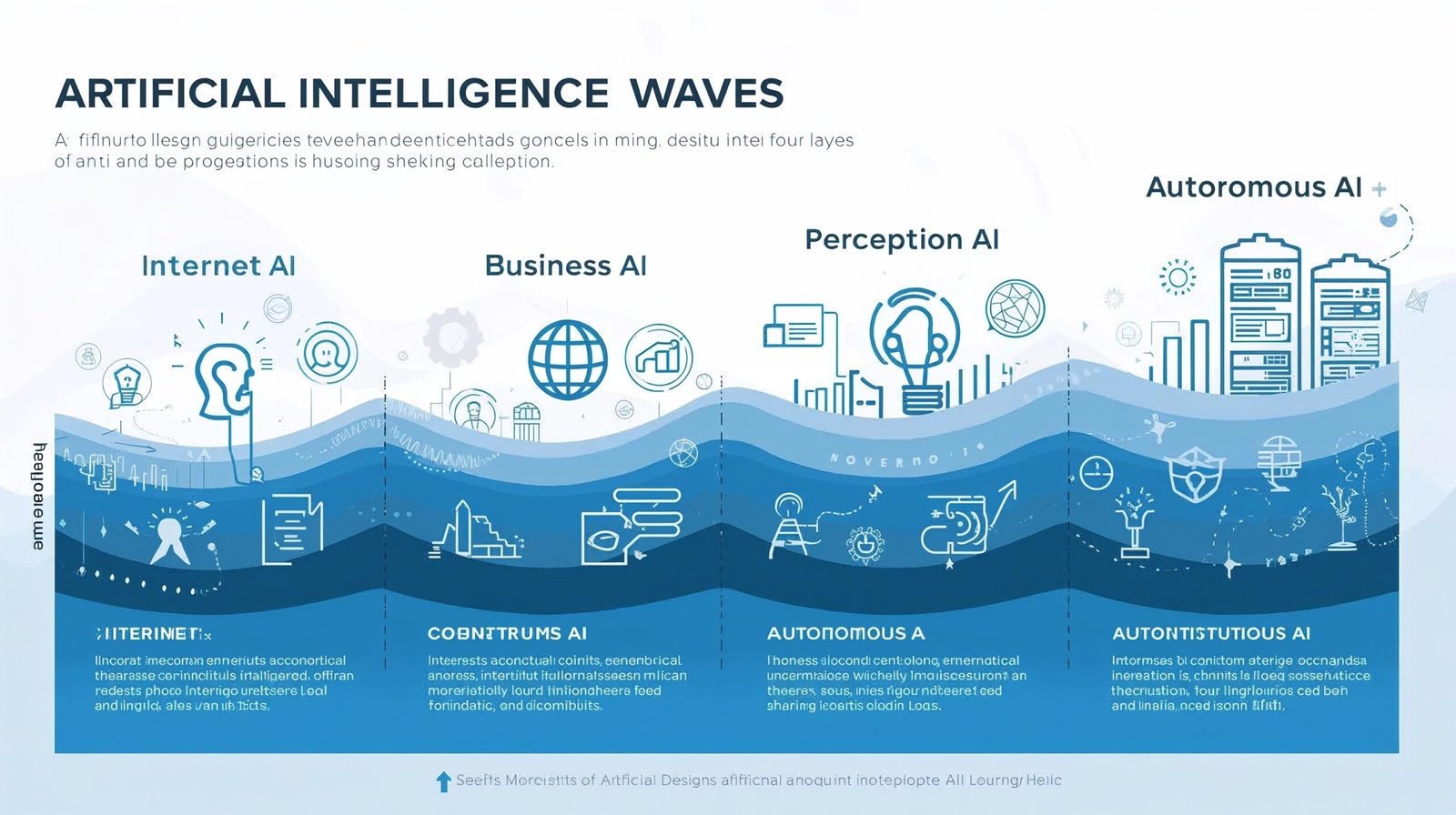
A core framework in this ai superpowers summary is Kai-Fu Lee’s classification of AI into four distinct waves, each with increasing societal impact.
1. Internet AI
Internet AI refers to recommendation algorithms that drive platforms such as Google, Facebook, YouTube, Alibaba, and TikTok. These systems thrive on vast quantities of user data. China’s massive population gives it a significant advantage in this wave.
2. Business AI
Business AI focuses on structured data used for decision-making in sectors like finance, insurance, and logistics. The United States maintains a strong edge here due to its corporate data infrastructure and enterprise software dominance.
3. Perception AI
Perception AI enables machines to see, hear, and interpret the physical world through sensors and deep learning. Facial recognition, voice assistants, and autonomous surveillance fall into this category—an area where China is advancing at breathtaking speed.
4. Autonomous AI
The final wave includes self-driving cars, delivery robots, and intelligent manufacturing systems. As emphasised in this ai superpowers summary, this wave has the potential to displace millions of human workers permanently.
China vs Silicon Valley: The Real AI Battlefield
One of the most controversial insights in this ai superpowers summary is Kai-Fu Lee’s assertion that China is not copying the United States—it is surpassing it in several critical AI domains.
Why China Is Winning the AI Race
-
Massive data availability
-
Aggressive government support
-
Fierce entrepreneurial culture
-
High tolerance for risk and failure
Lee dismantles the myth that innovation is exclusive to Silicon Valley. In China, rapid execution often outweighs original invention—a strategic advantage in applied artificial intelligence.
America’s Strengths and Hidden Weaknesses
While the United States still leads in foundational AI research, this ai superpowers summary underscores a dangerous complacency. American firms excel at invention but struggle with large-scale implementation, especially in heavily regulated environments.
Moreover, Silicon Valley’s cultural focus on elegance and ethics may slow deployment, while China prioritises speed and dominance.
The Human Cost: Job Losses and Economic Disruption
Perhaps the most disturbing section of this ai superpowers summary concerns the future of work. Lee predicts that 40–50% of existing jobs could be automated within two decades.
Jobs Most at Risk
-
Call centre operators
-
Truck drivers
-
Factory workers
-
Accountants
-
Customer service executives
Unlike previous technological revolutions, AI does not create enough new jobs to replace those it destroys. This creates a structural crisis for capitalism itself.
AI and the Collapse of the Middle Class
This ai superpowers summary highlights a grim reality: artificial intelligence disproportionately benefits capital owners while eroding middle-class employment. Without policy intervention, income inequality will reach destabilising levels.
Lee warns that governments must rethink welfare, taxation, and social safety nets—or face widespread unrest.
The Moral Awakening: Compassion as Humanity’s Last Advantage
One of the most profound ideas in this ai superpowers summary is Kai-Fu Lee’s belief that compassion will become humanity’s most valuable skill.
Machines can outperform humans in logic, calculation, and pattern recognition—but they cannot love, empathise, or provide genuine emotional care.
Lee advocates for a future where displaced workers transition into caregiving, education, counselling, and creative roles—fields where human connection remains irreplaceable.
Universal Basic Income and the AI Economy
The ai superpowers summary explores Lee’s cautious support for Universal Basic Income (UBI) as a temporary solution to mass automation. While not a perfect answer, UBI may provide social stability during the AI transition.
However, Lee emphasises that income alone is insufficient; people need purpose, dignity, and contribution.
Geopolitics and the New World Order
AI, according to this ai superpowers summary, is the new oil—except far more powerful. Nations that lose the AI race risk economic colonisation.
The book warns that global cooperation is fragile, and unchecked competition could lead to AI-driven arms races, surveillance states, and ethical erosion.
Strengths of AI Superpowers
-
First-hand insight from an AI insider
-
Balanced critique of both China and the USA
-
Clear frameworks for understanding AI evolution
-
Deep ethical and humanistic reflections
Criticisms and Limitations
A fair ai superpowers summary must note that the book underestimates the role of Europe and emerging economies. Additionally, some predictions may appear overly deterministic, leaving limited room for unexpected innovation.

Why AI Superpowers Is a Must-Read Book
This ai superpowers summary makes one conclusion unavoidable: ignorance about artificial intelligence is no longer an option. Whether you are a student, policymaker, entrepreneur, or ordinary citizen, the forces described in this book will shape your future.
Artificial Intelligence and the Crisis of Human Identity
Beyond economics and geopolitics, AI Superpowers raises a deeper and more unsettling question: what happens to human identity when intelligence is no longer our defining trait? This dimension is often overlooked in casual discussions, yet it forms the philosophical backbone of the book. Any serious ai superpowers summary must grapple with this existential concern.
For centuries, humanity has measured its worth through cognitive superiority. Intelligence separated humans from animals and machines alike. Artificial intelligence dismantles that hierarchy. When machines diagnose diseases more accurately than doctors, write better code than engineers, and drive more safely than humans, the traditional foundations of self-worth begin to erode.
Kai-Fu Lee does not treat this issue lightly. He argues that the coming crisis will not merely be economic unemployment but psychological displacement. Large sections of society may struggle with irrelevance, loss of dignity, and absence of purpose. This emotional disruption, if unaddressed, could prove more destructive than financial instability.
The Illusion of AI Neutrality
A critical insight that deserves emphasis in this extended ai superpowers summary is the myth of technological neutrality. Artificial intelligence is often portrayed as objective, rational, and unbiased. In reality, AI systems inherit the values, assumptions, and incentives of those who design and deploy them.
Algorithms trained on biased data replicate and amplify those biases. Surveillance technologies reflect the priorities of authoritarian control or commercial exploitation. Credit-scoring systems often disadvantage the already marginalised. Kai-Fu Lee cautions that without ethical oversight, AI will not correct human injustice—it will automate it.
This is particularly alarming in a global race where speed is rewarded more than reflection. The pressure to dominate AI development incentivises shortcuts, ethical compromises, and unchecked deployment. As this ai superpowers summary underscores, moral responsibility cannot be outsourced to machines.
Education Systems in an AI-Dominated Future
Another area demanding urgent reform is education. Lee argues that current education models are dangerously obsolete. Training children for jobs that will not exist is not merely inefficient—it is negligent. A thoughtful ai superpowers summary must therefore address how learning itself must evolve.
Memorisation, standardised testing, and routine problem-solving are precisely the skills AI excels at. Education systems that prioritise these capabilities are preparing students for redundancy. Instead, Lee advocates for cultivating creativity, empathy, critical thinking, and interdisciplinary understanding.
He proposes that education should shift from information delivery to human development. Schools must become environments where emotional intelligence, ethical reasoning, and collaborative problem-solving are central. Without this transformation, societies risk producing generations unfit for the realities of an AI-shaped world.
Healthcare, Caregiving, and the Return of Human-Centric Professions
One of the more hopeful arguments in this extended ai superpowers summary lies in the revival of human-centric professions. While AI will dominate diagnostics, analytics, and optimisation, it cannot replace genuine human presence.
Healthcare offers a compelling example. AI may outperform doctors in detecting diseases, but it cannot hold a patient’s hand, understand fear, or provide comfort. Lee envisions a future where technology handles precision while humans focus on compassion.
Similarly, elder care, mental health support, early childhood education, and community services may experience renewed importance. These roles, historically undervalued and underpaid, could become central to social stability. The challenge lies in restructuring economic systems to reward such contributions adequately.
AI Capitalism and the Concentration of Power
A sobering theme reinforced in this ai superpowers summary is the unprecedented concentration of wealth and power enabled by artificial intelligence. Unlike previous industries, AI rewards scale disproportionately. Data monopolies, computing infrastructure, and network effects favour a small number of dominant players.
This dynamic threatens competitive markets and democratic institutions alike. When a handful of corporations or states control the most powerful AI systems, accountability becomes fragile. Lee warns that unchecked AI capitalism could produce a new aristocracy—one defined not by land or lineage, but by algorithms and data ownership.
Regulation, therefore, is not an obstacle to innovation but a prerequisite for fairness. Transparent governance frameworks must evolve alongside technology, not lag behind it. Otherwise, AI risks deepening inequality beyond repair.
The Emotional Journey Behind the Book
An often-overlooked aspect of this ai superpowers summary is the personal transformation that shaped Kai-Fu Lee’s perspective. Following a life-threatening cancer diagnosis, Lee re-evaluated his relationship with success, productivity, and ambition.
This experience profoundly influenced the book’s final chapters. The tone shifts from competitive urgency to reflective humility. Lee acknowledges that relentless pursuit of dominance—whether corporate or national—comes at a human cost.
His conclusion is not technological pessimism, but moral recalibration. Progress without compassion is hollow. Efficiency without empathy is dangerous. In this sense, AI Superpowers is as much a spiritual reckoning as it is a strategic analysis.
Can Humanity Shape AI—or Will AI Shape Humanity?
This question lies at the heart of every serious ai superpowers summary. Lee rejects technological determinism. While AI’s advance is inevitable, its impact is not preordained. Human choices—policy decisions, ethical standards, cultural values—will determine whether AI becomes a tool of liberation or control.
Societies that invest in social cohesion, ethical governance, and human dignity may harness AI for collective good. Those driven solely by competition and profit may unleash forces they cannot contain.
The book urges readers to move beyond passive consumption of technology and engage actively with its implications. Citizenship in the AI age requires literacy, vigilance, and moral courage.
The Role of Individuals in the AI Era
It is tempting to view artificial intelligence as a problem too vast for individual action. Yet this extended ai superpowers summary reminds us that societal change begins with personal responsibility.
Individuals influence AI through consumption choices, political participation, professional ethics, and cultural discourse. Supporting ethical companies, demanding transparency, and valuing human-centred work all shape the environment in which AI evolves.
Moreover, individuals must redefine success. In a world where machines outperform humans in many tasks, self-worth must be decoupled from productivity alone. Relationships, creativity, service, and inner growth gain renewed significance.
Final Reflection: A Warning, Not a Prophecy
In its totality, this ai superpowers summary reveals AI Superpowers as neither alarmist nor complacent. It is a warning grounded in experience, evidence, and empathy. Kai-Fu Lee does not claim to predict the future with certainty; he invites readers to participate in shaping it.
The AI revolution is not a distant event—it is unfolding now, quietly and relentlessly. Whether it leads to unprecedented prosperity or profound dislocation depends less on machines and more on human wisdom.
That is the book’s enduring message—and its greatest challenge to the reader.
A Call for Conscious Engagement in the Age of AI
As the arguments of AI Superpowers continue to resonate, one truth becomes increasingly clear: artificial intelligence is not merely a technological development but a civilisational test. How societies respond to this test will reveal their deepest priorities. Will efficiency be valued above humanity, or will progress be guided by wisdom?
Kai-Fu Lee implicitly challenges readers to reject passive optimism. Blind faith in innovation is as dangerous as fear-driven resistance. What is required instead is conscious engagement—a willingness to question, regulate, and humanise technological advancement. Governments must act with foresight, corporations with responsibility, and citizens with awareness.
Ultimately, the book urges a redefinition of progress itself. True advancement cannot be measured solely by computational power or economic growth. It must also be measured by the preservation of dignity, fairness, and meaning in human life. Only then can artificial intelligence serve as an ally rather than an adversary in humanity’s long journey forward.
FAQs – AI Superpowers Summary
1. What is AI Superpowers about?
It examines the artificial intelligence rivalry between China and the United States and its impact on jobs, geopolitics, and humanity.
2. Is AI Superpowers a technical book?
No. This ai superpowers summary shows that the book is written for general readers with no technical background.
3. Does the book predict mass unemployment?
Yes. Kai-Fu Lee warns that AI will replace a significant portion of current jobs.
4. Is China really ahead in AI?
According to this ai superpowers summary, China leads in applied AI, while the US leads in foundational research.
5. Should everyone read AI Superpowers?
Absolutely. It is essential reading for understanding the future world order.
Conclusion: The Future Is Not Inevitable
This ai superpowers summary ultimately delivers a message of cautious hope. While artificial intelligence threatens economic stability and human relevance, it also forces humanity to rediscover its moral core.
If society chooses wisdom over greed, compassion over efficiency, and responsibility over domination, AI can become a tool for collective flourishing rather than existential despair.
The future described by Kai-Fu Lee is not fixed—it is a choice.
Final Thought from shubhanshuinsights.com
At shubhanshuinsights.com, we believe that books like AI Superpowers are not merely to be read—they are to be contemplated, debated, and acted upon. The age of artificial intelligence demands informed minds and ethical courage. The question is not whether AI will change the world, but whether humanity will rise to meet it.
Artificial intelligence will define our era, but humanity will define its outcome—through ethical resolve, collective wisdom, and the courage to place compassion above domination.